Mahmudul Hossain
Google Ads & Conversion Tracking Specialist
30 September 26
7 min read
Illustration by Fsdm Mahmudul
If you are deciding where to spend your ad money, the Google Ads vs Meta Ads question comes up fast. Both can bring you customers. But they work in very different ways, and picking the wrong one first can waste months and a good chunk of budget.
In this guide, our team explains how each platform works, when each one makes sense, how to use them together and what to track so you know which one is really paying off. No jargon, and no "one answer fits all."
We run both every week, through our Meta and Instagram ads management and our Google Ads management service, so the advice below comes from real accounts rather than theory.
The simplest way to understand Google Ads vs Meta Ads is to think about what the customer is doing when they see your ad.
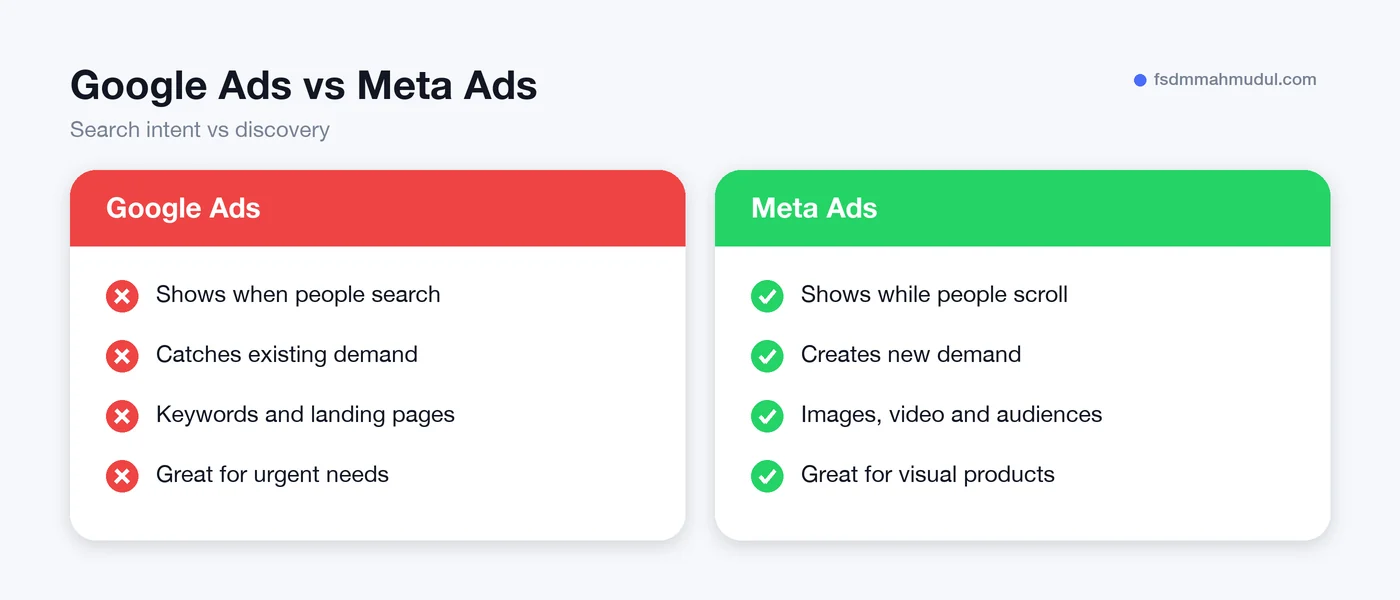
Google Ads shows your ad when someone searches for something. A person types "emergency plumber near me" or "running shoes for flat feet." They already know what they want. Your ad appears at the moment they are looking. This is called search intent.
Meta Ads (Facebook and Instagram) shows your ad while people scroll their feed, watch stories or browse reels. They were not looking for you. Your ad has to catch their eye and make them want something they had not thought about yet. This is called discovery.
Neither is better. They simply do different jobs:
On Google, you choose the searches you want to appear for (keywords), the area you serve and how much you are willing to pay for a click. Google also offers Shopping ads, which show your product photo and price right in the results, and Performance Max, which spreads your ads across Search, YouTube, Maps and more.
Because people are already searching, clicks often turn into sales or enquiries faster. The trade-off is that you can only reach as many people as are searching. If nobody searches for your product, Google cannot invent that demand for you.
On Meta, you target people rather than searches. You can show ads by location, age, interests and behaviour, or let Meta's algorithm find buyers for you based on who has already bought. You can also reach people who visited your website but did not buy, which is called retargeting.
The trade-off here is that people are not in "buying mode." Your images and videos (your creative) do most of the work. A weak picture or a dull first second of video, and people scroll straight past.
| Google Ads | Meta Ads | |
|---|---|---|
| What the customer is doing | Searching for a solution | Scrolling, watching, browsing |
| Best at | Catching existing demand | Creating new demand |
| Main lever | Keywords, bids and landing pages | Images, videos and audiences |
| Works well for | Urgent services, known products | Visual products, impulse buys, new ideas |
| Typical weak spot | Limited by how many people search | People are not ready to buy yet |
| Tracking needs | Google Ads conversion tracking | Meta Pixel plus Conversions API |
Google tends to make more sense first when:
If you choose Google, our simple Google Ads budget guide shows how to work out a sensible starting spend from your own numbers.
Meta tends to make more sense first when:
Meta is also strong for bringing back visitors who left without buying. A reminder ad on Instagram can nudge someone who was close to checking out.
For many eCommerce brands and growing local businesses, the real answer is not "either or." It is "both, in the right order."
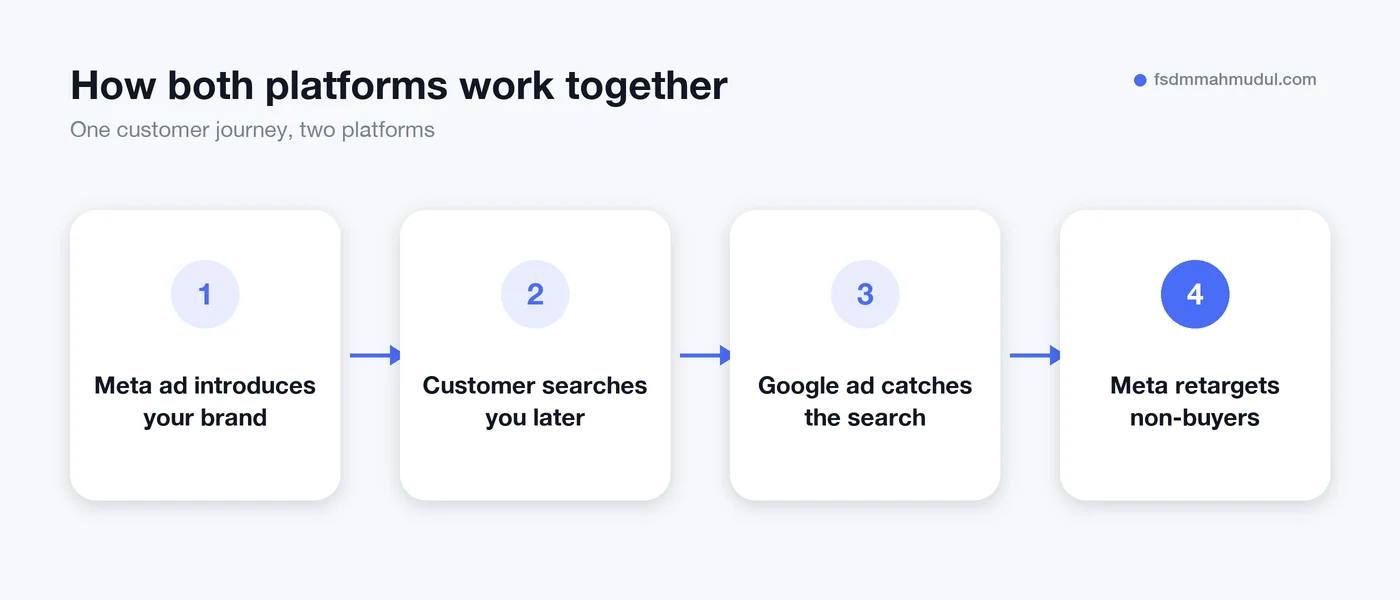
A common pattern looks like this:
In this setup, each platform can make the other look better or worse than it really is. Meta might start the journey, while Google gets the final click and the credit. That is why tracking matters so much before you judge either one.
Our advice: start with the platform that fits your business best, prove it works, then add the second one. Running both at once on a small budget usually means neither gets enough data to learn.
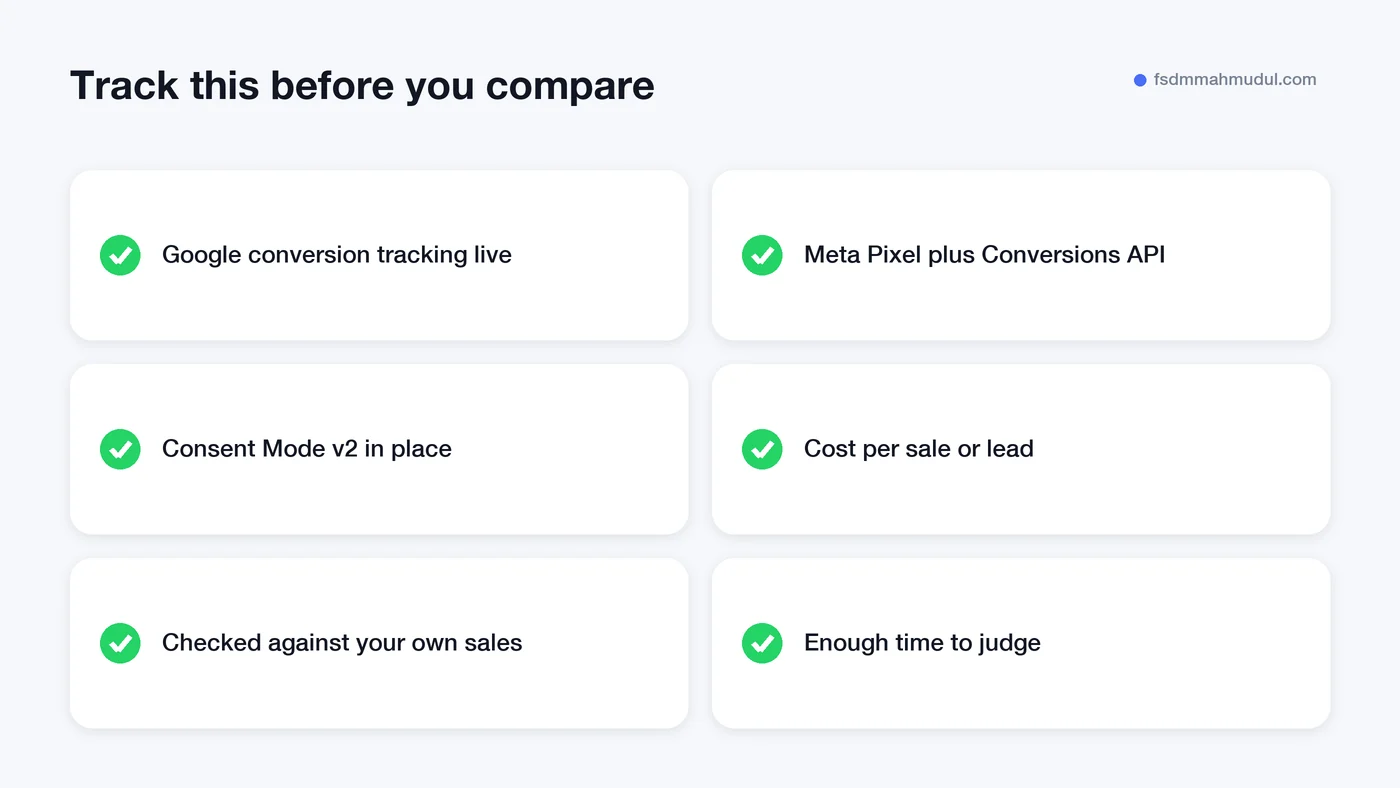
You cannot compare Google Ads vs Meta Ads fairly if your tracking is broken. Before you judge either platform, check that:
You can see how we set up this kind of tracking in our Meta Pixel and Conversions API portfolio work.
These are the mistakes we see most often when owners choose between the two.
Neither is simply cheaper. Costs change by industry, location, season and how well your ads are set up. What matters is your cost per sale or lead compared with what a customer is worth to you. Test with a set budget and compare those numbers.
For urgent or local services, Google Ads is often the better first step, because people search when they need you. Meta can still help local businesses with visual offers, events or building awareness in a set area.
It depends on the product. If people already search for it, Google Shopping or Performance Max is a strong start. If it is visual or new, Meta often works better first. Many shops end up using both.
Yes, once you have enough budget and working tracking on both. Start with one, prove it, then add the other. The two often work best together, with Meta finding new buyers and Google catching the searches that follow.
The Google Ads vs Meta Ads choice is not about which platform is "best." It is about where your customers are and what they are doing when they find you. Our team has helped 50+ clients over 5+ years make that call, including one account that tracked €109K in revenue from €11K in ad spend.
If you want a clear recommendation for your business, book a free ads audit and we will show you where your budget should go first.
We can review your current setup and show which issue should be addressed first.
Get My Free AuditHere are answers to the questions people ask us most. Can't find yours? Message us and we usually reply within an hour.

We review your campaigns, tracking or conversion journey, then show you the main issue limiting performance, its business impact and a practical next step.
Yes. Most clients start from $1,000 a month in ad spend. We will tell you honestly if your budget is too small.
A dedicated specialist from our team runs your account day to day, and Mahmudul oversees the strategy and reviews the results. You always have one point of contact, so you never have to chase anyone.
No. Work is month to month and you can cancel any time.
Always. Your accounts, campaigns and tracking stay yours, even if we stop working together.
Wasted spend usually drops in the first 2 weeks. Steady growth shows by month 2 or 3.
Clients in Bangladesh, the US, UK, Canada, Australia and Europe. Our team works across time zones.
Request a free audit or message us on WhatsApp. We confirm the audit is a good fit, share our findings or invite you to a review, then agree the next step with Mahmudul.
Yes. Our tracking specialist checks that every sale, lead and call is counted correctly, because good ads need good data.
Yes. We send clear, simple notes your developer can follow, or our own developer makes the changes for you.
With a team. Mahmudul leads a small group of specialists in ads, tracking, page design and website development. Each person works on what they know best, and Mahmudul checks the work before it reaches you. If someone is away, another team member covers for them, so your work never stops.
You get a simple monthly report showing what we spent, what we got back and what we will do next. Mahmudul reviews every report before it is sent.